I'm getting to know my new commute. This morning I rode with a friend (Mike); we can ride part way together, then he goes north and I go west. Just before we split up, Mike is usually joined by another guy, Chris. One thing I noticed is that when you're riding hour and a half in the morning and again in the afternoon, the weather conditions change significantly. I was freezing at first, but eventually the ambient temperature increased and I warmed up. On the way home, I was overdressed, but about halfway home the sun went down, the temperature dropped, and I was dressed about right.
This was Mike's first commute with his new Surly Long Haul Trucker; he said it was like riding a Cadillac compared to his old Trek hybrid. I said something about trying to meet up on the way home, but Mike said he's tried that and the timing never works out, so I resigned myself to a solo ride home.
I finished the commute and found that the last 3 miles consist of a series of short but sharp climbs and descents. I was pretty proud of how well I did on them. I found out on the return trip in the afternoon that they are much sharper climbs in the homeward direction, and not being fully warmed up, they pretty much kicked my butt.
A little later, I was just coming out to a main road and two commuters in hi-visibility jackets go by- It was Mike and Chris! They passed the side street I was on and kept right on rolling. I got out to the main road and was maybe a block or two behind them, but going downhill. They were coasting some, so I was able to catch up with them and we rode the rest of the way home together. Pretty cool.
Mike is a strong rider and has been doing a longer commute for some time. Still, I hung with him pretty good- until the long rise of Wedgmont Circle where he left me in the dust.
Being in the habit of commuting regularly, I thought I was a pro at it. But when you increase the distance from 7 to 17 miles each way, it's a whole new ballgame.
Showing posts with label winter commuting. Show all posts
Showing posts with label winter commuting. Show all posts
Monday, January 11, 2010


Monday, November 23, 2009
The Land of a Thousand Commutes
That's what Texas feels like this time of year. This morning was chilly, foggy and damp. I started out before sunrise and rode in. Here are a few scenes from my commute. Below: My new headlight that puts out 255 lumens is a big improvement over my old one.
I used to think cutting across a parking lot was a point of shame, but I've decided that certain parking lots do afford the best route for a cyclist. If I didn't turn into this parking lot I'd have to make a left turn at a major intersection. My bike won't trip the signal, and it might be three or four turns of a light before a car turns left at that spot.
Pea soup!
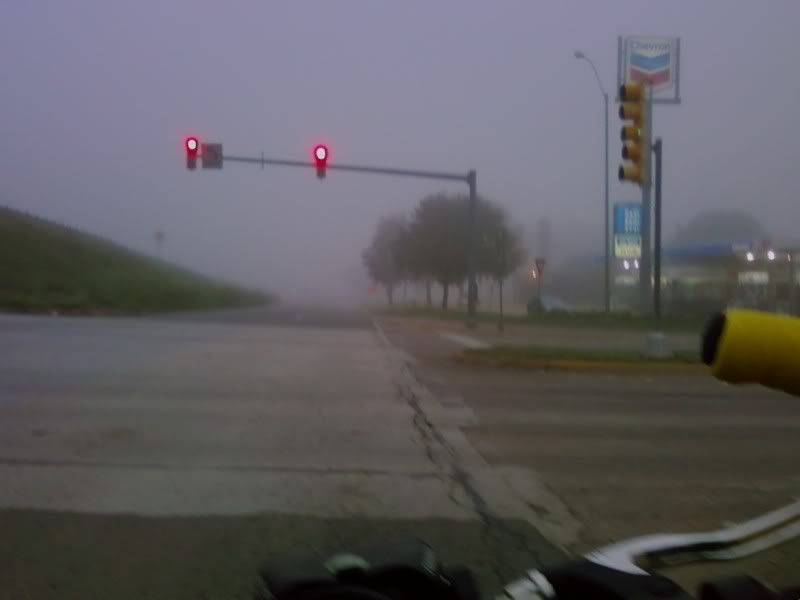
My commuter... This weekend I went from the Origin8 Space Bar I've run for several months back to the original flat bar, plus I added some bar ends, just to change things up a bit.
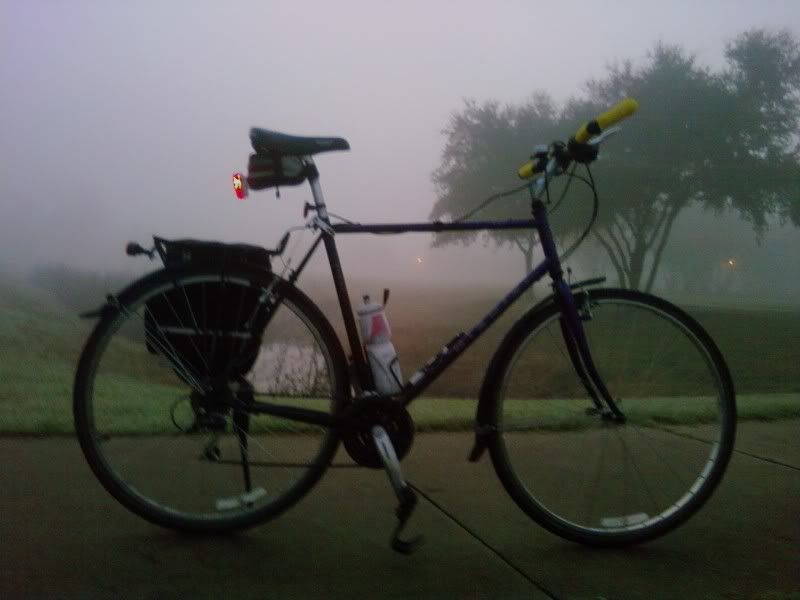
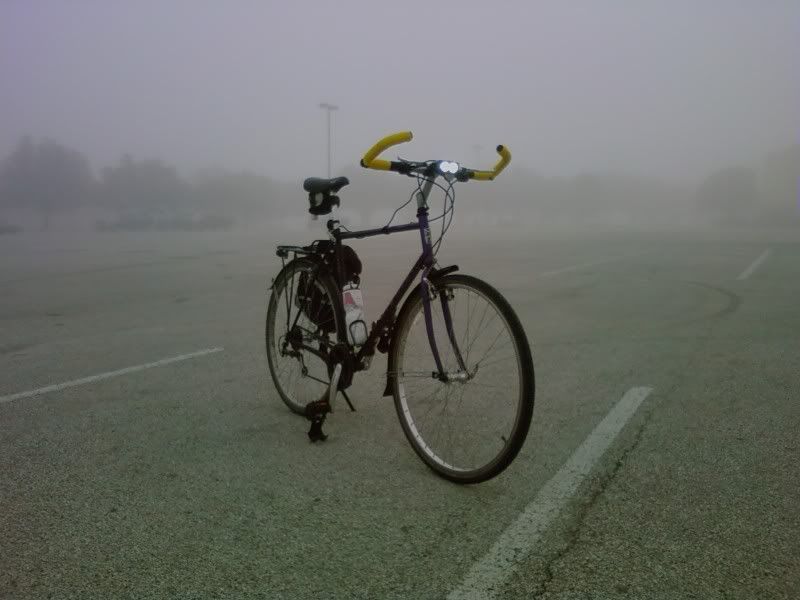
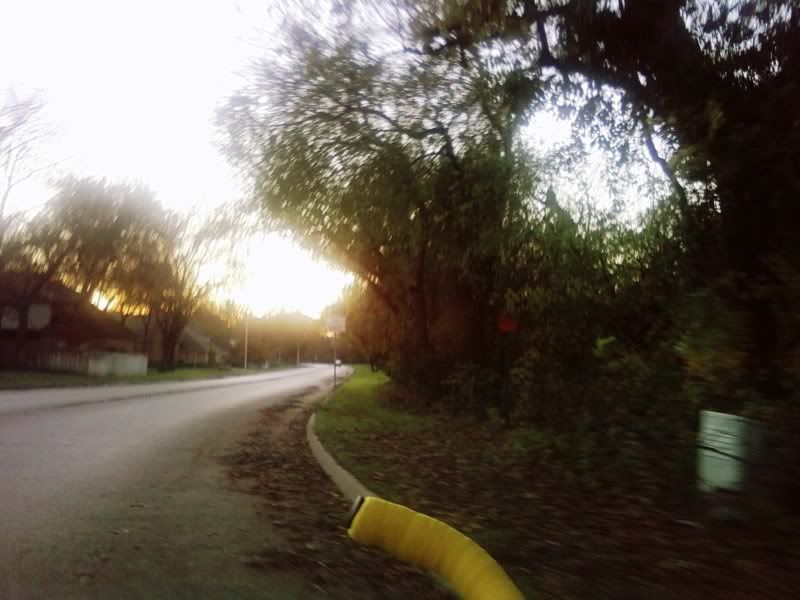
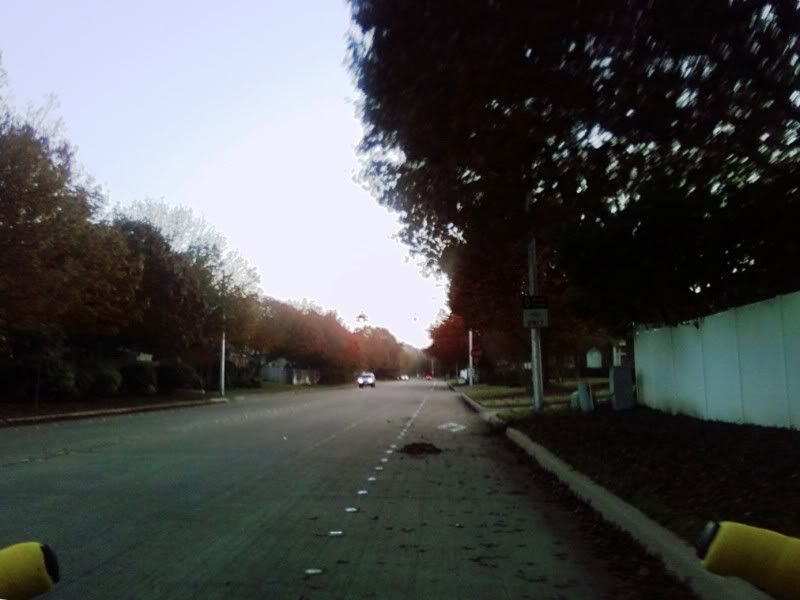
The ride home was a totally different story. The sun burned off the fog early and was still shining a bit when I left for home. But this being fall, it didn't hang around long.
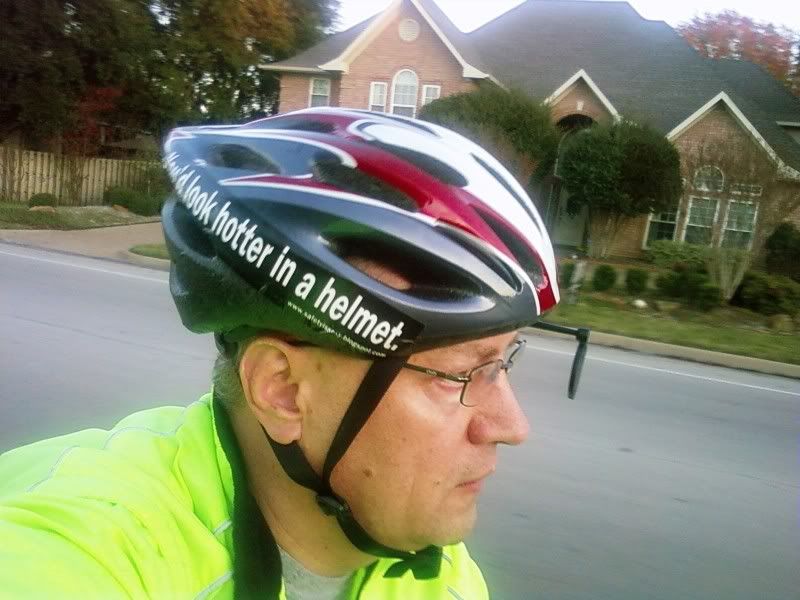
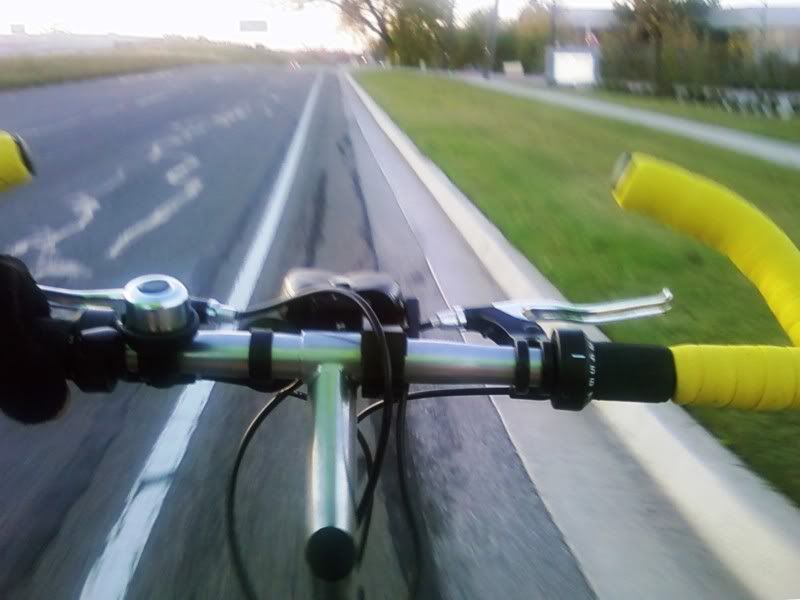
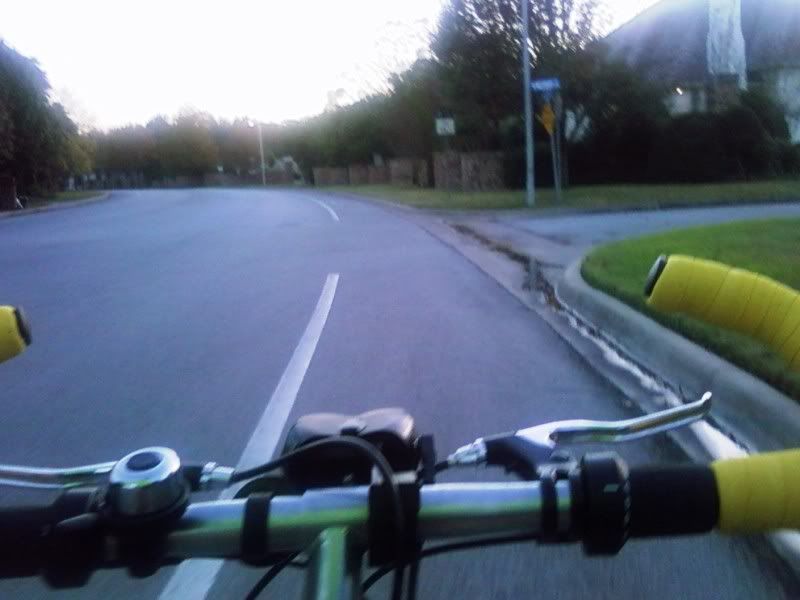
Riding into the sunset.
I think I'll wait for the green light, thanks...
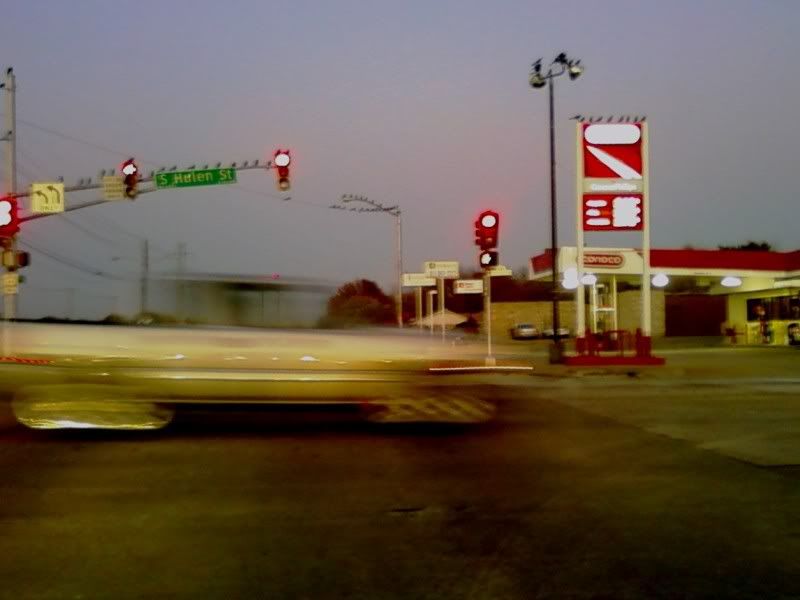
In fifteen minutes it went from the twilight above to the total darkness below. Talk about night falling!
I made it home, safe and sound. The new headlight is a Cygolite Rover II LED with 25 Watts and 255 lumens. It's a big improvement. Now for the back I'd like to get one more PlanetBike Superflash so I can leave one on steady and put the other in blink mode.
I used to think cutting across a parking lot was a point of shame, but I've decided that certain parking lots do afford the best route for a cyclist. If I didn't turn into this parking lot I'd have to make a left turn at a major intersection. My bike won't trip the signal, and it might be three or four turns of a light before a car turns left at that spot.
Pea soup!
My commuter... This weekend I went from the Origin8 Space Bar I've run for several months back to the original flat bar, plus I added some bar ends, just to change things up a bit.
The ride home was a totally different story. The sun burned off the fog early and was still shining a bit when I left for home. But this being fall, it didn't hang around long.
Riding into the sunset.
I think I'll wait for the green light, thanks...
In fifteen minutes it went from the twilight above to the total darkness below. Talk about night falling!
I made it home, safe and sound. The new headlight is a Cygolite Rover II LED with 25 Watts and 255 lumens. It's a big improvement. Now for the back I'd like to get one more PlanetBike Superflash so I can leave one on steady and put the other in blink mode.
Monday, November 09, 2009
A Notable Commute
I figured I would take a nice leisurely evening ride home that included a few miles on the Trinity River Trail. We've had a wet fall, but no rain for the last week or two. Where I get on the trail I have to go over one of the low water crossings. Would it be clear? Well, it was dry... kind of. A little muddy. But there was a lot of debris on the crossing. You know, little twigs and stuff.... like this:


I was determined though so I cyclocrossed the low-water crossing and went up the other side. I got to the other low-water crossing where I usually cross back and waddya know? This one was still flooded.

So now I had to ride a few more miles down the trail and get off at a point where I can take a road bridge across. I settled in for the longer ride and started pushing the pedals. I noticed a headlight behind me on the trail that was getting closer and closer. The guy finally caught up to me and it turned out to be a good friend of mine. We've known each other for years, but never rode together. I found out why.... this guy can really hammer away. Still, he preferred to ride with a partner and had pity on me and allowed me to hang around. I hadn't ridden in almost a week, had a leisurely ride into work (read: I had no energy) and this afternoon wasn't much better. I didn't want to hold him up too much, so I pushed harder than I really wanted to.
We did probably about 10 miles together before splitting up about a block from his house. I rode the mile or so to my house and nearly collapsed from exhaustion. It was a great ride. :)
I was determined though so I cyclocrossed the low-water crossing and went up the other side. I got to the other low-water crossing where I usually cross back and waddya know? This one was still flooded.
So now I had to ride a few more miles down the trail and get off at a point where I can take a road bridge across. I settled in for the longer ride and started pushing the pedals. I noticed a headlight behind me on the trail that was getting closer and closer. The guy finally caught up to me and it turned out to be a good friend of mine. We've known each other for years, but never rode together. I found out why.... this guy can really hammer away. Still, he preferred to ride with a partner and had pity on me and allowed me to hang around. I hadn't ridden in almost a week, had a leisurely ride into work (read: I had no energy) and this afternoon wasn't much better. I didn't want to hold him up too much, so I pushed harder than I really wanted to.
We did probably about 10 miles together before splitting up about a block from his house. I rode the mile or so to my house and nearly collapsed from exhaustion. It was a great ride. :)
Thursday, October 22, 2009
Hardcore?
People are starting to tie that word to me and my bicycle commuting. Yesterday, for instance, I rode into the teeth of 30 mph gusting winds on a day that saw 4 inches of rain locally.
I can see where they're coming from, but I don't really see it that way. There are times when I rarely commute. The two weeks prior to this week, I only rode to work one day. We have a leak in the roof and I had to be available to come home quickly if an insurance adjuster or roofing guy came by. So.... I had to drive.
This week started with beautiful weather. With a more favorable schedule I decided to try to ride to work all five days. Monday and Tuesday were great: mid-50s in the morning, mid-70s in the afternoon. No problem.
Wednesday was a different matter. Significant rainfall was predicted. It was iffy. I checked outside and it was wet but it wasn't raining. I got ready to ride, packed up the bike and set out, only to find a steady rain that increased as I rode. On days like that, I tell my wife, "Well, as long as I can get to work okay, if I have to, I catch a ride home with someone." Her reply is usually a sardonic, "Yeah. Right." She knows that if I ride to work, I ride home. So far I haven't let bad weather stop me.
When I got to work, I was soaked head-to-toe like someone had sprayed me with the garden hose. Despite the wind and rain I wasn't too cold; the temp was in the 60s. It was a pretty wild ride, the worst weather in which I'd ridden to work. At the end of the day, my nylon jacket was dry, but the long sleeve t-shirt I'd worn was soaked, so I just rode home in my work shirt. The ride home was a repeat of the ride in, except it was raining hard the whole way, the wind was now in my face, and because it had rained all day there was a lot of street flooding, up to the frame of the bike.
This morning I was better prepared. The radar showed the rain was still around, a check outside confirmed it. I dressed similarly to the previous day, except that I put a hat on under my helmet and added a vinyl raincoat under my hi-visibility windbreaker. It was about ten degrees cooler, but when I started out... no rain! So I was over-dressed and a little too warm. I hit some rain just as I got close to work, though, so the vinyl layer paid off.
This afternoon was a piece of cake. Not only had it warmed into the 70s, but the wind was at my back for a change.
Tomorrow I plan to ride, which will make this the first week in quite a while that I've commuted all five days in a work week.
So... why was I so hardcore this week? Well first of all, I had challenged myself to ride all five days for a change. My work schedule usually prevents this because of meetings I have away from my office on Wednesdays, but I didn't have any meetings this week (I was in a training class). So there was that.
When the rains rolled in it would have been easy to back out of riding, but there is something else that kicks in when conditions get bad. If I'm up to it, I like to push the envelope of conditions in which I'll ride. I won't say I would always ride in conditions like that, but it makes life interesting to challenge myself occasionally. There is the rush of meeting the challenge, when the ride is almost an adventure. I wouldn't want to do it all the time, but I like to push the limits once in a while.
And yeah, there's this: I love the look of disbelief when people in the office find out I've ridden to work through terrible weather. It doesn't bother me one bit if they think I'm just a little crazy.
Ultimately though, what it comes down to is I'm not hardcore. I'm a fool.
I can see where they're coming from, but I don't really see it that way. There are times when I rarely commute. The two weeks prior to this week, I only rode to work one day. We have a leak in the roof and I had to be available to come home quickly if an insurance adjuster or roofing guy came by. So.... I had to drive.
This week started with beautiful weather. With a more favorable schedule I decided to try to ride to work all five days. Monday and Tuesday were great: mid-50s in the morning, mid-70s in the afternoon. No problem.
Wednesday was a different matter. Significant rainfall was predicted. It was iffy. I checked outside and it was wet but it wasn't raining. I got ready to ride, packed up the bike and set out, only to find a steady rain that increased as I rode. On days like that, I tell my wife, "Well, as long as I can get to work okay, if I have to, I catch a ride home with someone." Her reply is usually a sardonic, "Yeah. Right." She knows that if I ride to work, I ride home. So far I haven't let bad weather stop me.
When I got to work, I was soaked head-to-toe like someone had sprayed me with the garden hose. Despite the wind and rain I wasn't too cold; the temp was in the 60s. It was a pretty wild ride, the worst weather in which I'd ridden to work. At the end of the day, my nylon jacket was dry, but the long sleeve t-shirt I'd worn was soaked, so I just rode home in my work shirt. The ride home was a repeat of the ride in, except it was raining hard the whole way, the wind was now in my face, and because it had rained all day there was a lot of street flooding, up to the frame of the bike.
This morning I was better prepared. The radar showed the rain was still around, a check outside confirmed it. I dressed similarly to the previous day, except that I put a hat on under my helmet and added a vinyl raincoat under my hi-visibility windbreaker. It was about ten degrees cooler, but when I started out... no rain! So I was over-dressed and a little too warm. I hit some rain just as I got close to work, though, so the vinyl layer paid off.
This afternoon was a piece of cake. Not only had it warmed into the 70s, but the wind was at my back for a change.
Tomorrow I plan to ride, which will make this the first week in quite a while that I've commuted all five days in a work week.
So... why was I so hardcore this week? Well first of all, I had challenged myself to ride all five days for a change. My work schedule usually prevents this because of meetings I have away from my office on Wednesdays, but I didn't have any meetings this week (I was in a training class). So there was that.
When the rains rolled in it would have been easy to back out of riding, but there is something else that kicks in when conditions get bad. If I'm up to it, I like to push the envelope of conditions in which I'll ride. I won't say I would always ride in conditions like that, but it makes life interesting to challenge myself occasionally. There is the rush of meeting the challenge, when the ride is almost an adventure. I wouldn't want to do it all the time, but I like to push the limits once in a while.
And yeah, there's this: I love the look of disbelief when people in the office find out I've ridden to work through terrible weather. It doesn't bother me one bit if they think I'm just a little crazy.
Ultimately though, what it comes down to is I'm not hardcore. I'm a fool.
Thursday, October 01, 2009
Rain, rain...
The ride home today made me feel like R A N T W I C K. Rain, wind, the rumble of thunder, more rain, wild temperature swings. I love it.
The blurriness is a testament to how wet the cell phone was.
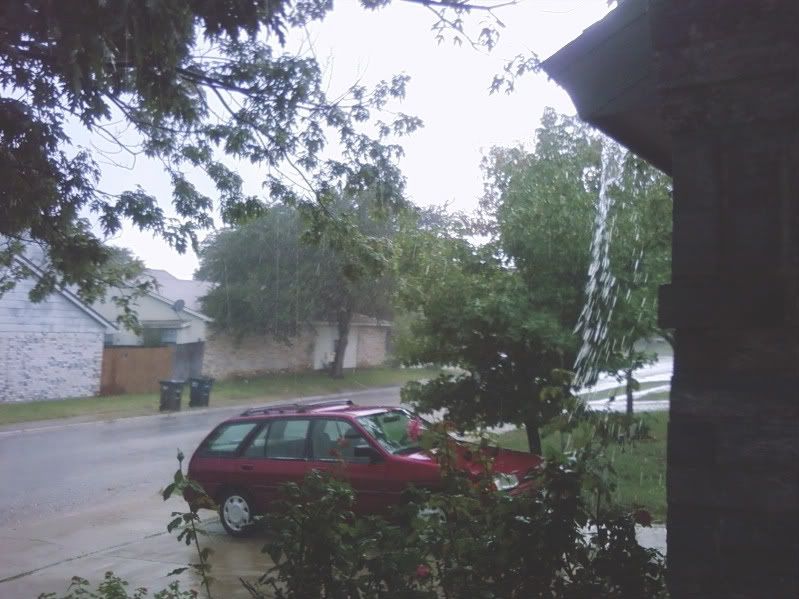
Cats & dogs...
I had the pleasure of sharing my commute in to work with a fellow cycle commuter, if only for several blocks. I saw him ahead of me and made the effort to catch up. The reason I saw him ahead of me is that he runs a Planet Bike Superflash (just like I do). You can see those from a long way off! That is a comfort to me, to know that I'm that visible from behind.
The blurriness is a testament to how wet the cell phone was.
Cats & dogs...
I had the pleasure of sharing my commute in to work with a fellow cycle commuter, if only for several blocks. I saw him ahead of me and made the effort to catch up. The reason I saw him ahead of me is that he runs a Planet Bike Superflash (just like I do). You can see those from a long way off! That is a comfort to me, to know that I'm that visible from behind.
Thursday, September 24, 2009
A Little Something for the Ladies
Earlier this year, there were a couple posts on dressing for colder weather. Those posts assumed that all commuters are guys, and maybe some unisex-dressing ladies. There was a recent post on Let's Go Ride a Bike that tackled this issue in a decidedly softer fashion. I invite you to click over to Dottie's post where she shares her tips for staying warm fashionably. Nice post, Dottie!

Saturday, September 19, 2009
Cyclists Unite! We Have Nothing to Lube But Our Chains!
More advice from ChipSeal

Home after the commute in the rain, should the bicycle be put away wet? Yes and no.
Steve noticed grit everywhere when he was done acting like a six year old, (Fifteenth comment.) and you will have a grit problem whenever you ride in the rain or at a beach.
Road or beach sand acts as an abrasive on your chain, gears, brake pads and rims. This is the stuff we want to remove after a ride in the rain. Then we want to re-lubricate the chain.
First thing when you get home, before you dry off, grab a rag and a hose and spray down your bike. I recommend doing this on the front lawn. If it is still raining, and your neighbors notice you, it will confirm their suspicions as to your mental state! If they ask you about it just say; "Don't worry, the bicycle likes it!"
Your first target should be the undersides of your fenders with the bike on its side. This will stop all that crud stuck under there from falling down on the newly cleaned parts or messing with your parking space. (For ChipSeal, that would be his bedroom.)
Then stand the bike up and spray downward over the entire bicycle. A hard spray can force water into the frame cavity through cable guides, water bottle screws and other tiny holes. It won't hurt most bottom brackets, but it can be hard on any part that has iron in it. (If it is "real", if you know what I mean!)
After a quick rinse, open your brakes and and give the face of the pads a good hard spray. Run your fingertips along the face and dislodge any grains of sand lodged there. This will keep the pads performance top notch and prevent deep scoring of the rim, extending it's useful life.
Many brake pads seem to melt in the rain. You may find your rims smeared with black residue and streaks down your fork and seat stays. Now is the easiest time to remove it while it is still wet, and why you brought a rag. In my case, my reflective tape's performance will have been compromised by this phenomena.
After a final rinse of your rims and brakes, close your brakes to avoid a surprise and spray down all of your chain and gears. Hard spray is fine. Don't be afraid to overdo it. Then park the bike where it can drip dry and get out of your wet clothes.
Later, lube your chain. I use a two step spray and wax lube method. Sheldon Brown didn't, but said there were many legitimate camps. So I will describe what I do, and hope not to start any fights.
I use White Lightning Clean Streak degreaser. This will remove all the lube and dirt left on your chain, and displace all that water as well.
I use cardboard to protect my rims from over-spray and later, over-drip. Spray the Clean Sweep generously on the chain while rotating it back wards in your favorite chain ring. The wipe with rags for about five chain rotations. If it is still picking up black, repeat the process. Then let it air for about ten minutes.
I use Rock and Roll lubrication "Red", or as I learned from their product site, "Extreme". I follow their directions, and I use it generously. This is a wax based lubrication, and it suits my cycling because it resists collecting dust. I a ride a bit on dirt roads.
These extra steps will diminish the extra wear your bicycle receives by riding in the rain. I will not take them if there is little evidence of grit on the bike. Once you see a gritty bike, you will see it is not hard to see.
If you anticipate a long ride or commute in the rain, you may want to consider taking along some chain lube to apply.
I have found a few parts on my single-speed to have an inclination to rust. The bolts on my stem and water bottle cages. You may wish to give them a shot of Pledge Protection Plus.
My wet cycling shoes get stuffed with newspaper for about ten minutes, and then I take it out and replace it with more dry newspaper.
And now it is your turn. What do you do when you come home wet?

Sunday, January 25, 2009
Winter Commuting
Commuting by bike in the winter is a heck of a lot easier than you would think. With the proper clothing, equipment, and attitude it can be done in a cinch.
Clothing
When it comes to cycling in the cold, the most important thing to remember is to wear layers. I have ridden in temperatures all the way down to -4 degrees F and been completely fine with proper layering.
Top Half: I base my layers upon the relative temperature outside, but what works for me may not work for everyone, so I suggest experimenting with your own body in this case.
40-50 Degrees F: Normal wear, meaning a wife beater and a long sleeve tshirt, with a wind breaker on top.
32-39 Degrees F: Moisture wicking base layer(such as under armour cold gear, or wool shirt), followed by either a long sleeve tshirt or a lightweight long sleeve wool shirt. Wind breaker on top as before.
20-32 Degrees F: Moisture wicking base layer, wool sweater, wind breaker.
0-20 Degrees F: Moisture wicking base layer, jersey or another moisture wicking tshirt, heavy wool sweater, wind breaker.
Below 0 Degrees F: The lowest I have ridden in was -4, with wind chill of -21; I wore Moisture wicking base layer, light wool sweater, heavy wool sweater, wind breaker; I was completely warm on top and dry.
Bottom Half: Now your legs are a little trickier to pin point, they warm up quicker than anything else since you use them the most.
40-50 Degrees F: I just wear normal pants, usually jeans or windproof running pants.
25-39 Degrees F: Thermal lined wind/waterproof running pants(picked them up at Goodwill for 3 bucks).
15-25 Degrees F: Either thermal underwear(long johns) or moisture wicking base layer, either jeans or wind/water proof pants.
(-) 0-15 Degrees F: Thermal underwear, thermal lined wind/waterproof pants, windbreaker style pants.
Extremities: These are very important, since they will be the first parts of your body which can sustain frostbite.
40-50 Degrees F: Light gloves(if any), normal crew socks and running shoes, ear band(fleece ear band sold in sports stores for around 5-10 dollars)
25-40 Degrees F: Heavy half glove/half mittens(purchased at a Tractor Supply sotre for 6 dollars, they are half finger length gloves that have a mitten piece than can be pulled over your fingers when needed...perfect for most any weather.) Wool hiking socks(smartwool 10 dollars) running shoes, fleece balaclava for head.
10-25 Degrees F: Heavy glove/mittens; wool hiking socks, thick crew socks, leather boots; fleece balaclava--and depending upon the weather a helmet cover...I use a plastic shopping bag...but Nashbar makes a fancy one for 20 bucks.
Anything below 10 F: Light gloves, heavy gloves/mittens; wool hiking socks, heavy wool socks, hiking boots; fleece balaclava, fleece ear band, helmet cover.
As I said these are examples of what I wear, you may need to adjust things a little to get comfortable. The general rule of thumb is when you walk outside you should feel a little chilly, not cold, by the time you pedal through your first mile you'll be warmed up just fine. Always make sure to inspect your bike before leaving so you can potentially avoid stopping and being out in the cold for long periods of time. If you feel you have under dressed, don't be afraid to turn around and go get another layer--better safe than sorry; if you feel you have over dressed, pedal easier or remove a layer, but never your outer wind shell...it is the most important layer.
Equipment:
To be successful at commuting during the winter you will need a few extra things for the bike that you will not usually need in the spring-summer-early fall months.
Lights: In the late fall and through the winter most of us deal with it being dark when we leave for work, and dark when we ride home at night. Though lights aren't necessarily for the cyclist's benefit, they are actually important so drivers and other riders can see you going down the road. Therefore lights are very important for winter cycling. You should acquire at least a head light and a tail light. I have a P7 flashlight which is one of the brightest lights you can purchase, I bought mine off of DealXtreme.com for 90 dollars with a mount, two batteries, the light, and a charger. For my tail light I have a Cateye TD1100 it has 10 bright led lights that have 5 different flash sequences to catch drivers attention, for a while it was the brightest light of it's kind, now there are brighter, but this one is still sufficient. The general rule is: The more lights you have on the bike, the better off you are.
Fenders: Some riders will disagree with the importance of fenders for winter cycling, but I am a firm believer in not having water/mud/snow spray all over my back and especially not all over my face. The concept is pretty simple, it is more likely to be wet in the winter...therefore you will need fenders.
Snow Tires: Now in Central KY where I live we don't get a ton of snow, usually we get one or two significant snowfalls per year. Therefore I merely have a back up set of wheels for my commuter bike that has knobby, mountain bike tires on them. It has snowed once this year around 6 inches and I spent nearly 2 hours riding around and having fun in the snow without any problem with the back up wheels.
However in areas that get more snowfall than a few inches per year might consider investing in a set of studded tires. Studded tires are usually mountain bike style tires with sharp pieces of metal sticking out of the knobs all over the tire. These studs actually give you a better grip when turning or trying pedal in thick snow/ice.
Homemade Emergency Kit: I personally believe it is better to be safe than sorry. Now my work is only 1 mile away from my house at the shortest distance, though I frequently extend my commute to being 5 miles or more each way. Therefore I could technically get by without an emergency kit, but it is best to have one. This is not anything elaborate, merely a few additions to your seat/frame bag/ backpack/pannier. An emergency blanket--you can get them online or in any first aid kit you buy at a drug store. Cell Phone--sure most of us already carry a cell phone, but if you don't have one, it may be a good idea to get a cheap prepaid cell phone with 20 minutes or so for emergency calls. Food-Be it a powerbar, a piece of fruit, granola, trail mix, or whatever you wish that is along those lines--if something was to happen and you were stuck walking in the cold or you were injured the food would act as a source of energy, and can warm you from the inside. Finally 20 dollars--You never know when conditions could turn for the worse and you may need emergency cab fare, or even money to buy a new tube.
Mindset:
Getting in the right mindset is one of the most important things for winter commuting. If you constantly think "I don't want to do it," or "It is just too cold," then you will never be able to commit to riding in the cold. Once you convince yourself that it is actually an enjoyable experience to ride in the winter you will be much better off. Half the battle is the mental battle.
One thing I do is try to get excited about the ride in the morning, I love to ride anyway so I just remind myself of that fact and try to plan what will go on on the ride in, sometimes I switch up the route I take to add excitement, other times I'll try to get to work faster than I ever have before; basically I make it a game to ride to work, which helps me forget about the cold.
Once you finally get out and ride to work a few times you will see how much fun winter cycling can be, you'll be hooked. Check out more information at Icebike.org --they truly have all the answers you need.
-MC
Clothing
When it comes to cycling in the cold, the most important thing to remember is to wear layers. I have ridden in temperatures all the way down to -4 degrees F and been completely fine with proper layering.
Top Half: I base my layers upon the relative temperature outside, but what works for me may not work for everyone, so I suggest experimenting with your own body in this case.
40-50 Degrees F: Normal wear, meaning a wife beater and a long sleeve tshirt, with a wind breaker on top.
32-39 Degrees F: Moisture wicking base layer(such as under armour cold gear, or wool shirt), followed by either a long sleeve tshirt or a lightweight long sleeve wool shirt. Wind breaker on top as before.
20-32 Degrees F: Moisture wicking base layer, wool sweater, wind breaker.
0-20 Degrees F: Moisture wicking base layer, jersey or another moisture wicking tshirt, heavy wool sweater, wind breaker.
Below 0 Degrees F: The lowest I have ridden in was -4, with wind chill of -21; I wore Moisture wicking base layer, light wool sweater, heavy wool sweater, wind breaker; I was completely warm on top and dry.
Bottom Half: Now your legs are a little trickier to pin point, they warm up quicker than anything else since you use them the most.
40-50 Degrees F: I just wear normal pants, usually jeans or windproof running pants.
25-39 Degrees F: Thermal lined wind/waterproof running pants(picked them up at Goodwill for 3 bucks).
15-25 Degrees F: Either thermal underwear(long johns) or moisture wicking base layer, either jeans or wind/water proof pants.
(-) 0-15 Degrees F: Thermal underwear, thermal lined wind/waterproof pants, windbreaker style pants.
Extremities: These are very important, since they will be the first parts of your body which can sustain frostbite.
40-50 Degrees F: Light gloves(if any), normal crew socks and running shoes, ear band(fleece ear band sold in sports stores for around 5-10 dollars)
25-40 Degrees F: Heavy half glove/half mittens(purchased at a Tractor Supply sotre for 6 dollars, they are half finger length gloves that have a mitten piece than can be pulled over your fingers when needed...perfect for most any weather.) Wool hiking socks(smartwool 10 dollars) running shoes, fleece balaclava for head.
10-25 Degrees F: Heavy glove/mittens; wool hiking socks, thick crew socks, leather boots; fleece balaclava--and depending upon the weather a helmet cover...I use a plastic shopping bag...but Nashbar makes a fancy one for 20 bucks.
Anything below 10 F: Light gloves, heavy gloves/mittens; wool hiking socks, heavy wool socks, hiking boots; fleece balaclava, fleece ear band, helmet cover.
As I said these are examples of what I wear, you may need to adjust things a little to get comfortable. The general rule of thumb is when you walk outside you should feel a little chilly, not cold, by the time you pedal through your first mile you'll be warmed up just fine. Always make sure to inspect your bike before leaving so you can potentially avoid stopping and being out in the cold for long periods of time. If you feel you have under dressed, don't be afraid to turn around and go get another layer--better safe than sorry; if you feel you have over dressed, pedal easier or remove a layer, but never your outer wind shell...it is the most important layer.
Equipment:
To be successful at commuting during the winter you will need a few extra things for the bike that you will not usually need in the spring-summer-early fall months.
Lights: In the late fall and through the winter most of us deal with it being dark when we leave for work, and dark when we ride home at night. Though lights aren't necessarily for the cyclist's benefit, they are actually important so drivers and other riders can see you going down the road. Therefore lights are very important for winter cycling. You should acquire at least a head light and a tail light. I have a P7 flashlight which is one of the brightest lights you can purchase, I bought mine off of DealXtreme.com for 90 dollars with a mount, two batteries, the light, and a charger. For my tail light I have a Cateye TD1100 it has 10 bright led lights that have 5 different flash sequences to catch drivers attention, for a while it was the brightest light of it's kind, now there are brighter, but this one is still sufficient. The general rule is: The more lights you have on the bike, the better off you are.
Fenders: Some riders will disagree with the importance of fenders for winter cycling, but I am a firm believer in not having water/mud/snow spray all over my back and especially not all over my face. The concept is pretty simple, it is more likely to be wet in the winter...therefore you will need fenders.
Snow Tires: Now in Central KY where I live we don't get a ton of snow, usually we get one or two significant snowfalls per year. Therefore I merely have a back up set of wheels for my commuter bike that has knobby, mountain bike tires on them. It has snowed once this year around 6 inches and I spent nearly 2 hours riding around and having fun in the snow without any problem with the back up wheels.
However in areas that get more snowfall than a few inches per year might consider investing in a set of studded tires. Studded tires are usually mountain bike style tires with sharp pieces of metal sticking out of the knobs all over the tire. These studs actually give you a better grip when turning or trying pedal in thick snow/ice.
Homemade Emergency Kit: I personally believe it is better to be safe than sorry. Now my work is only 1 mile away from my house at the shortest distance, though I frequently extend my commute to being 5 miles or more each way. Therefore I could technically get by without an emergency kit, but it is best to have one. This is not anything elaborate, merely a few additions to your seat/frame bag/ backpack/pannier. An emergency blanket--you can get them online or in any first aid kit you buy at a drug store. Cell Phone--sure most of us already carry a cell phone, but if you don't have one, it may be a good idea to get a cheap prepaid cell phone with 20 minutes or so for emergency calls. Food-Be it a powerbar, a piece of fruit, granola, trail mix, or whatever you wish that is along those lines--if something was to happen and you were stuck walking in the cold or you were injured the food would act as a source of energy, and can warm you from the inside. Finally 20 dollars--You never know when conditions could turn for the worse and you may need emergency cab fare, or even money to buy a new tube.
Mindset:
Getting in the right mindset is one of the most important things for winter commuting. If you constantly think "I don't want to do it," or "It is just too cold," then you will never be able to commit to riding in the cold. Once you convince yourself that it is actually an enjoyable experience to ride in the winter you will be much better off. Half the battle is the mental battle.
One thing I do is try to get excited about the ride in the morning, I love to ride anyway so I just remind myself of that fact and try to plan what will go on on the ride in, sometimes I switch up the route I take to add excitement, other times I'll try to get to work faster than I ever have before; basically I make it a game to ride to work, which helps me forget about the cold.
Once you finally get out and ride to work a few times you will see how much fun winter cycling can be, you'll be hooked. Check out more information at Icebike.org --they truly have all the answers you need.
-MC
Monday, January 19, 2009
Clothing Considerations
When you ride your bike to work, you watch the weather more closely. Not that it helps in the beginning. For me it was a crap shoot- sometimes I did better than others. When there's a big change in the weather I sometimes miss the optimum. However, with some practice I've developed some guidelines that seem to get me close.
One thing I heard early on is that if you're not cold the first mile or two, you're overdressed. There's some truth to this. The exception is if you're riding in a stiff breeze. If you start out cold, it will take much longer to warm up if the wind is blowing through your clothes.
I dress according to the weather, and sometimes I will be able to wear some portion of my work clothes while I ride. I'm just now starting to get dedicated bicycling gear; most of my commutes have been with normal clothes. Here's what I've figured out so far:
60 degrees F and above:
Bottom: Shorts or short bike pants.
Top: T-shirt or a short-sleeve bike jersey.
If the temps are in the 60s or above, you will pretty much warm up instantly. If it's windy, you might want to wear long sleeves.
50 to 60 degrees F:
Bottom: Shorts or short bike pants.
Top: short-sleeve t-shirt and a long-sleeve t-shirt, or long-sleeve t-shirt and light windbreaker.
I don't use them at this temperature, but many people like to wear either leg warmers, tights, or long bike pants for temps in the 50s. In fact, one rider in my club swears I am doing terrible damage to my knees by leaving them uncovered at this temperature. Phah, I say.
And as for windbreakers, I have one of these (as mentioned in a previous post):
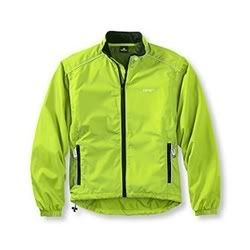
It's tailored for cycling and the more I use it, the more I like it. Like other cycling tops it's longer in the back than in the front, it has several pockets with zippers, and one pocket is actually a pouch that the jacket can can fold up and store in. Also the sleeves can be vented or removed with zippers.
40 to 50 degrees F:
Bottom: Jeans, or short bike pants with tights/leg warmers, or long bike pants.
Top: T-shirt, sweat shirt & light windbreaker, or t-shirt, long sleeve t-shirt, and sweatshirt.
Other: Light gloves or full-fingered cycling gloves, maybe a hat or pull up the hood from your sweatshirt under your helmet.
The first time I did the hood thing, I pulled up the hood and pulled my helmet on, resulting in a tunnel-vision effect; I had very poor peripheral vision. I find that I have to put the edge of the hood on my hairline and no lower, and buckle the helmet strap such that it holds the sides of the hood back, to get good visibility.
30 to 40 degrees F:
Bottom: Jeans, or long bike pants.
Top: T-shirt, long-sleeve t-shirt, sweat shirt & light windbreaker. Substituting a turtleneck for the long-sleeve t-shirt keeps your neck warm.
Other: Light gloves or full-fingered cycling gloves, plus a hat or pull up the hood from your sweatshirt under your helmet.
As the temp gets down into the lower 30s you may want to consider a face covering like a balaclava.
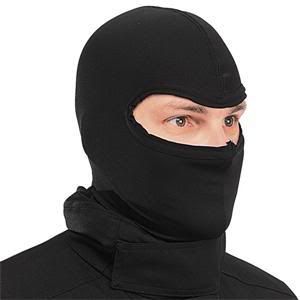
I wear glasses and so far haven't needed anything more than that for my face. But when I wear a balaclava, my glasses steam up if I'm stopped or moving slowly, unless I pull the balaclava down below my mouth. Otherwise my warm, moist breath comes up under my glasses and they fog up.
20 to 30 degrees F:
Bottom: Jeans with either tights or long underwear.
Top: T-shirt, long-sleeve t-shirt (or turtleneck), sweat shirt & light windbreaker.
Other: Heavier gloves (mine are fur-lined) or full-fingered cycling gloves for cold weather, plus balaclava. Toward the low end of the the temperature range a hat or hood may be needed with the balaclava.
I haven't gotten below that yet; the coldest I've seen here in Texas is 22 degrees F.
As a general rule, I don't ride to work if it's already raining. If I am caught at work and have to get home I'll go for it, figuring I can take a hot shower when I get home.
As for my routine upon arriving at work, I take a change of clothes with me. If I wore jeans on my ride, I usually use those for work. I take a change of socks and underwear and a work shirt. If I want to wear a sweater at work, I may use that for one of my layers when I'm riding. I'm lucky in that I park my bike in a closet that I can lock so I can change in there. I strip down, take a "baby powder shower" (I take a normal shower before leaving home), and put on fresh deodorant. Then a take a washcloth, hand towel and a comb over to the bathroom and rinse off my face, rinse out my hair, dry off and comb my hair. Pretty much no one can tell I've ridden my bike.
Because my bike is in a storage closet I can hang up my riding clothes on the backs of chairs in there and they dry off during the day. The best suggesting I've heard if you don't have anywhere to hang up riding clothes is to tightly pack them in a plastic bag and seal it. The only problem with that is you really can't use them for the ride home. You either have to wear your work clothes or you have to bring a third set of clothes for the ride home.
There is the fear of forgetting something, but it becomes routine pretty quickly. If you're worried about forgetting anything, maybe make a check list and/or get all your stuff ready the night before.
One thing I heard early on is that if you're not cold the first mile or two, you're overdressed. There's some truth to this. The exception is if you're riding in a stiff breeze. If you start out cold, it will take much longer to warm up if the wind is blowing through your clothes.
I dress according to the weather, and sometimes I will be able to wear some portion of my work clothes while I ride. I'm just now starting to get dedicated bicycling gear; most of my commutes have been with normal clothes. Here's what I've figured out so far:
60 degrees F and above:
Bottom: Shorts or short bike pants.
Top: T-shirt or a short-sleeve bike jersey.
If the temps are in the 60s or above, you will pretty much warm up instantly. If it's windy, you might want to wear long sleeves.
50 to 60 degrees F:
Bottom: Shorts or short bike pants.
Top: short-sleeve t-shirt and a long-sleeve t-shirt, or long-sleeve t-shirt and light windbreaker.
I don't use them at this temperature, but many people like to wear either leg warmers, tights, or long bike pants for temps in the 50s. In fact, one rider in my club swears I am doing terrible damage to my knees by leaving them uncovered at this temperature. Phah, I say.
And as for windbreakers, I have one of these (as mentioned in a previous post):
It's tailored for cycling and the more I use it, the more I like it. Like other cycling tops it's longer in the back than in the front, it has several pockets with zippers, and one pocket is actually a pouch that the jacket can can fold up and store in. Also the sleeves can be vented or removed with zippers.
40 to 50 degrees F:
Bottom: Jeans, or short bike pants with tights/leg warmers, or long bike pants.
Top: T-shirt, sweat shirt & light windbreaker, or t-shirt, long sleeve t-shirt, and sweatshirt.
Other: Light gloves or full-fingered cycling gloves, maybe a hat or pull up the hood from your sweatshirt under your helmet.
The first time I did the hood thing, I pulled up the hood and pulled my helmet on, resulting in a tunnel-vision effect; I had very poor peripheral vision. I find that I have to put the edge of the hood on my hairline and no lower, and buckle the helmet strap such that it holds the sides of the hood back, to get good visibility.
30 to 40 degrees F:
Bottom: Jeans, or long bike pants.
Top: T-shirt, long-sleeve t-shirt, sweat shirt & light windbreaker. Substituting a turtleneck for the long-sleeve t-shirt keeps your neck warm.
Other: Light gloves or full-fingered cycling gloves, plus a hat or pull up the hood from your sweatshirt under your helmet.
As the temp gets down into the lower 30s you may want to consider a face covering like a balaclava.
I wear glasses and so far haven't needed anything more than that for my face. But when I wear a balaclava, my glasses steam up if I'm stopped or moving slowly, unless I pull the balaclava down below my mouth. Otherwise my warm, moist breath comes up under my glasses and they fog up.
20 to 30 degrees F:
Bottom: Jeans with either tights or long underwear.
Top: T-shirt, long-sleeve t-shirt (or turtleneck), sweat shirt & light windbreaker.
Other: Heavier gloves (mine are fur-lined) or full-fingered cycling gloves for cold weather, plus balaclava. Toward the low end of the the temperature range a hat or hood may be needed with the balaclava.
I haven't gotten below that yet; the coldest I've seen here in Texas is 22 degrees F.
As a general rule, I don't ride to work if it's already raining. If I am caught at work and have to get home I'll go for it, figuring I can take a hot shower when I get home.
As for my routine upon arriving at work, I take a change of clothes with me. If I wore jeans on my ride, I usually use those for work. I take a change of socks and underwear and a work shirt. If I want to wear a sweater at work, I may use that for one of my layers when I'm riding. I'm lucky in that I park my bike in a closet that I can lock so I can change in there. I strip down, take a "baby powder shower" (I take a normal shower before leaving home), and put on fresh deodorant. Then a take a washcloth, hand towel and a comb over to the bathroom and rinse off my face, rinse out my hair, dry off and comb my hair. Pretty much no one can tell I've ridden my bike.
Because my bike is in a storage closet I can hang up my riding clothes on the backs of chairs in there and they dry off during the day. The best suggesting I've heard if you don't have anywhere to hang up riding clothes is to tightly pack them in a plastic bag and seal it. The only problem with that is you really can't use them for the ride home. You either have to wear your work clothes or you have to bring a third set of clothes for the ride home.
There is the fear of forgetting something, but it becomes routine pretty quickly. If you're worried about forgetting anything, maybe make a check list and/or get all your stuff ready the night before.
Saturday, January 17, 2009
Bicycle Snow Plow!
This is for advanced bicycle commuters only! Dave Peterson in Illinois, a dedicated bicycle commuter, decided to take unplowed bicycle paths into his own hands. He designed, built, and operates his own bicycle-towed snow plow.
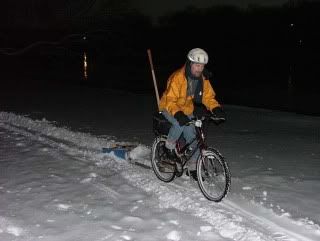
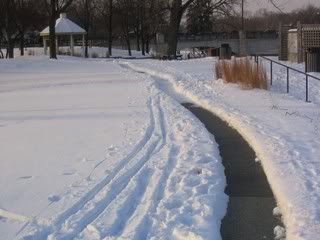
Read more here. The moral of the story is that when you think weather conditions are too tough to commute on your bike, there's a way.
Read more here. The moral of the story is that when you think weather conditions are too tough to commute on your bike, there's a way.
Subscribe to:
Posts (Atom)